


If you’ve ever heard people in marketing meetings say, let’s just run some Performance Marketing and let’s implement a Growth Marketing strategy, you are not alone in wondering if these are the same thing. They don’t — and knowing the difference could actually make all the difference in the effectiveness of your marketing budget.
Every day, at Clarity Growth Advisory, brands are asking us exactly this, where should my money go? And what really yields results? Let’s start with the terms as they are used by people.
What Is Performance Marketing?
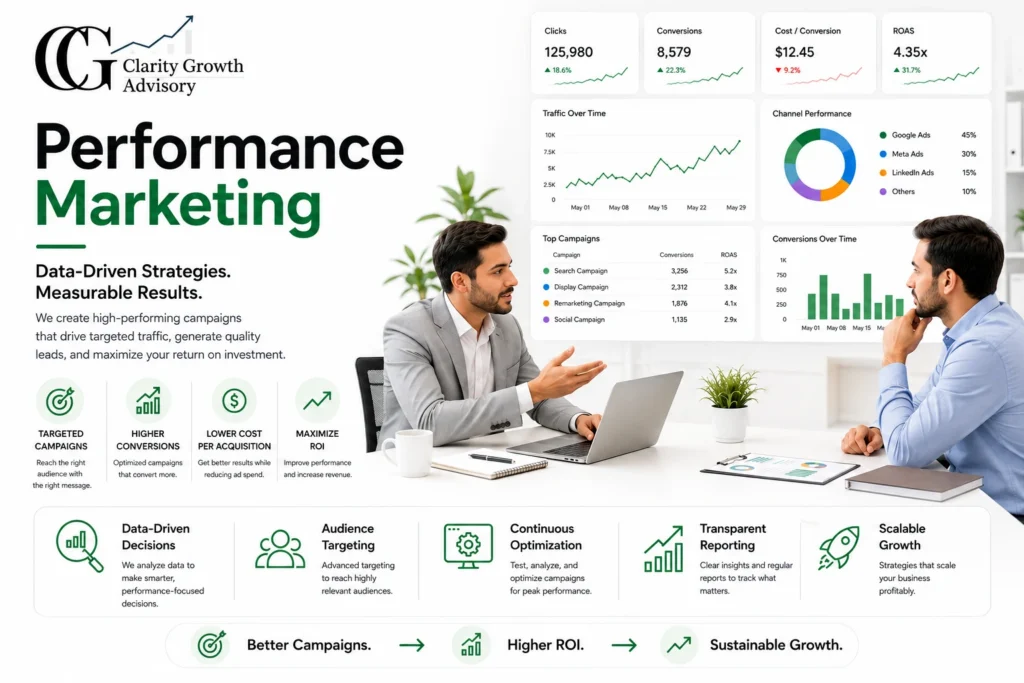
Performance marketing is the part of marketing you can measure almost instantly. Think Google Ads, Meta campaigns, influencer collaborations paid on conversions, or affiliate marketing — channels where you pay for a specific, trackable outcome. A click. A sign-up. A sale.
The draw: The customer is guaranteed what they pay for. With a spend of ₹10,000 and 50 acquirable sales, you can work out your cost per acquisition, down to the rupee. The clarity is one of the reasons so many businesses rely on performance marketing for its initial approach — it seems safe, it seems like the easy method, it seems like the approach that holds immediate promise.
But here’s the catch. Performance marketing is fantastic at generating short-term results, yet it doesn’t always build something lasting. Turn off the ad spend, and often, the leads stop coming too.
What Is Growth Marketing, Then?
Growth marketing takes a wider, more patient view. Instead of asking “how do we get a sale today,” it asks “how do we build a system that keeps generating sales, month after month, without constantly pouring in fresh budget.”
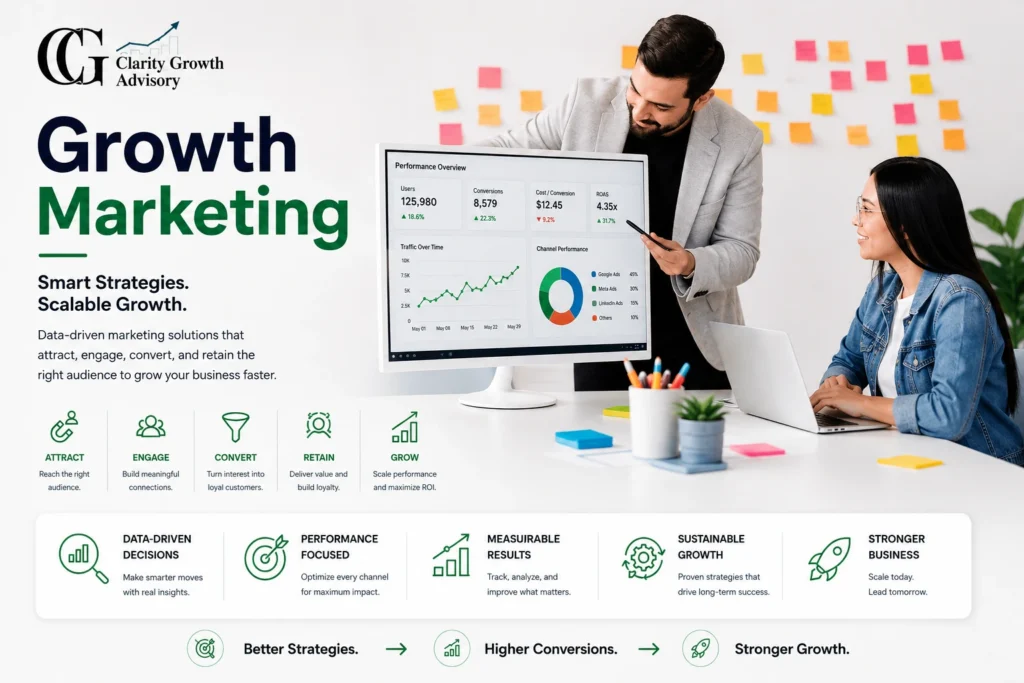
Growth marketing pulls together SEO, content, email nurturing, retention strategy, product-led growth, referral loops, and yes — performance marketing too — into one connected engine. It’s less about a single campaign and more about compounding results over time.
Where performance marketing chases the next conversion, Businesses that rely only on performance marketing often hit a ceiling growth marketing asks what happens after that conversion. Does the customer come back? Do they refer a friend? Does your brand get remembered, not just clicked on.
Performance Marketing and Growth Marketing — Working Together
Here’s the honest truth: this isn’t really an either-or choice. The smartest businesses use performance marketing as fuel and growth marketing as the engine.
Performance marketing brings in quick wins and the data you need to understand your audience — which messages convert, which audiences respond, what your real cost per customer looks like. Growth marketing then uses that data to create a more long-term framework: improved retention campaigns, more intelligent content, higher brand awareness, and systems that will decrease your reliance on paid media over time.
The instant budgets tighten up, there is an increase in costs, ad fatigue and a decrease in growth. Without any performance marketing, many businesses that only use growth marketing grow too slowly to be competitive. The actual benefit is when they’re deliberately mixed.
How to Know Which One Your Business Needs Right Now
For newer brands, where you are still determining who is your customer, performance marketing can give you rapid feedback, and prove your concepts. If you’ve got pretty good traction already and you continue to spend money to keep up the same level of traction you’re paying to rent your customers.If you already have some solid traction, and you’re just spending money to maintain what you already have, there probably is a growth marketing layer that can help you retain more customers, earn more referrals, and generate more organic traffic that you don’t have to constantly pay for.
This is exactly the kind of diagnostic work we focus on at Clarity Growth Advisory — helping brands figure out where they actually sit on this spectrum, instead of guessing.
Conclusion
Performance marketing and growth marketing aren’t competing philosophies — they’re two gears in the same machine. One gets you moving quickly, the other keeps you moving sustainably. The businesses that grow best over the long run are usually the ones that stop picking a side and start using both, at the right moment, in the right proportion.
If your marketing feels like it’s constantly restarting from zero, it might be time to shift some of that energy from short-term performance marketing into a real growth marketing strategy — one built to compound, not just convert.
Frequently Asked Questions
1. What is the main difference between performance marketing and growth marketing?
Whereas paid, trackable action (such as clicks and sales) is a primary target of performance marketing, retention, content, and multiple connected channels constitute the cornerstones of growth marketing.
2. Which is better for a new business — performance marketing or growth marketing?
Performance marketing is often a better choice for new businesses because it offers quicker and more measurable results, and it can be used to test the waters before taking a site to a larger growth marketing campaign.
3. Can performance marketing and growth marketing be used together?
Yes, actually, the best businesses do both, doing data for sustainable, long-term customer relations and performance in between for fast wins.
4. Why does growth marketing take longer to show results than performance marketing?
Growth marketing relies on organic channels, retention, and referrals, which take time to build momentum, whereas performance marketing generates immediate, paid-for outcomes.
5. How does Clarity Growth Advisory help businesses choose between the two?
Clarity Growth Advisory evaluates where a brand currently stands — early-stage or scaling — and designs a tailored mix of performance marketing and growth marketing to match its specific growth goals and budget.
